AP Invoice Approval Status
Description:
Imported from Concurrent Program Application: Payables Source: Invoice Approval Status Short Name: APXAPRST
Parameters
Reporting Level, Reporting Context, Sort By, Trading Partner, Supplier Site, Approver, Invoice Date From, Invoice Date To, Status
Used tables
ap_inv_aprvl_hist_all, ap_invoices_all, gl_ledgers, ap_suppliers, ap_supplier_sites_all, hz_parties, fnd_currencies, xle_entity_profiles, ap_lookup_codes, mo_glob_org_access_tmp, dual, ap_invoice_lines_all
Categories
Dependencies
If you would like to try one of these Oracle EBS SQLs without having Blitz Report installed, note that some of the reports require functions from utility package xxen_util.
Example Report
AP Invoice Approval Status - By Approver 18-Jul-2024 070508.xlsx
Report SQL
www.enginatics.com/reports/ap-invoice-approval-status/
Blitz Report™ import options
AP_Invoice_Approval_Status.xml
Case Study & Technical Analysis: AP Invoice Approval Status
1. Executive Summary
Business Problem
In complex organizations, tracking the approval status of invoices is critical for financial control and operational efficiency. Accounts Payable (AP) departments often struggle with:
- Lack of Visibility: Difficulty in determining where an invoice is stuck in the approval workflow.
- Audit Compliance: Challenges in providing a clear audit trail of who approved what and when.
- Process Bottlenecks: Inability to identify approvers who consistently delay payments.
- Cash Flow Management: Uncertainty about upcoming cash outflows due to pending approvals.
Solution Overview
The AP Invoice Approval Status report provides a comprehensive view of the invoice approval history and current status. It bridges the gap between the AP invoice data and the approval workflow history, offering a unified view for AP managers and auditors.
Key Benefits
- Enhanced Visibility: Real-time tracking of invoice approval status across the organization.
- Improved Efficiency: Rapid identification of bottlenecks in the approval process.
- Audit Readiness: Complete history of approval actions, including dates and approver identities.
- Financial Control: Better management of invoice holds and payment schedules.
2. Functional Analysis
Report Purpose
This report is designed to list invoices along with their approval status and history. It is particularly useful for organizations using Oracle Payables Invoice Approval Workflow (AME or standard workflow) to manage invoice approvals.
Key Metrics & Data Points
- Invoice Details: Invoice Number, Date, Amount, Currency, Supplier Name, Site.
- Approval Status: Current status (e.g., Approved, Rejected, Initiated, Needs Reapproval).
- Workflow History: Approver Name, Action Date, Action Taken (Approve, Reject, Delegate).
- Aging: Days since the invoice was received or the approval process started.
Intended Audience
- AP Managers: To monitor team performance and approval bottlenecks.
- AP Clerks: To follow up on specific invoices stuck in approval.
- Internal Auditors: To verify compliance with approval limits and delegation rules.
- Controllers: To assess potential liabilities and cash requirements.
3. Technical Analysis
Source Tables
The report primarily joins AP invoice data with approval history tables:
AP_INVOICES_ALL: Core invoice header information.AP_INV_APRVL_HIST_ALL: Historical record of approval actions for each invoice.AP_SUPPLIERS&AP_SUPPLIER_SITES_ALL: Supplier master data.GL_LEDGERS: Ledger context.HZ_PARTIES: Party information for approvers.FND_CURRENCIES: Currency definitions.
Critical Logic
- Approval History Join: The report links invoices to their approval history using
INVOICE_ID. It handles multiple approval iterations (e.g., if an invoice was rejected and resubmitted). - Approver Identification: It resolves the approver’s ID to a user-friendly name, often requiring joins to HR or FND user tables depending on the implementation.
- Status Interpretation: The report translates system status codes into business-friendly terms (e.g., ‘WFAPPROVED’ to ‘Workflow Approved’).
Performance Considerations
- Indexing: Ensure
AP_INV_APRVL_HIST_ALLis indexed onINVOICE_IDfor efficient joining. - Date Ranges: The report includes parameters for
Invoice Date FromandToto limit the dataset and prevent full-table scans on large transaction tables.
4. Implementation Guide
Setup Instructions
- Deploy SQL: Copy the provided SQL query into your reporting tool (e.g., Blitz Report, BI Publisher).
- Configure Parameters: Set up the standard parameters:
Ledger: To filter by specific entity.Date Range: To control the reporting period.Supplier: Optional filter for vendor-specific analysis.Approver: Optional filter to audit specific users.
- Security: Ensure the report responsibility has access to the underlying AP and HR tables.
Usage Scenarios
- Daily Operations: Run daily to identify invoices pending approval for more than 5 days.
- Month-End Close: Run to ensure all material invoices are approved and accounted for before closing the period.
- Audit Requests: Run for a specific sample of invoices to demonstrate approval compliance.
5. Frequently Asked Questions (FAQ)
Q: Why does an invoice show multiple approval records?
A: If an invoice is rejected and resubmitted, or if it requires multiple levels of approval (e.g., Manager -> Director), each action is recorded as a separate line in the history.
Q: Can I see who the invoice is currently waiting on?
A: Yes, the report typically shows the ‘Pending’ action and the assigned approver for invoices that are not yet fully approved.
Q: Does this report cover AME (Approvals Management Engine) rules?
A: Yes, since AME writes back to the standard AP approval history tables, this report reflects the outcomes of AME rules.
Oracle E-Business Suite Reporting Library
We provide an open source Oracle EBS SQLs as a part of operational and project implementation support toolkits for rapid Excel reports generation.
Blitz Report™ is based on Oracle EBS forms technology, and hence requires minimal training. There are no data or performance limitations since the output files are created directly from the database without going through intermediate file formats such as XML.
Blitz Report can be used as BI Publisher and Oracle Discoverer replacement tool. Standard Oracle BI Publisher and Discoverer reports can also be imported into Blitz Report for immediate output to Excel. Typically, reports can be created and version tracked within hours instead of days. The concurrent request output automatically opens upon completion without the need for re-formatting.
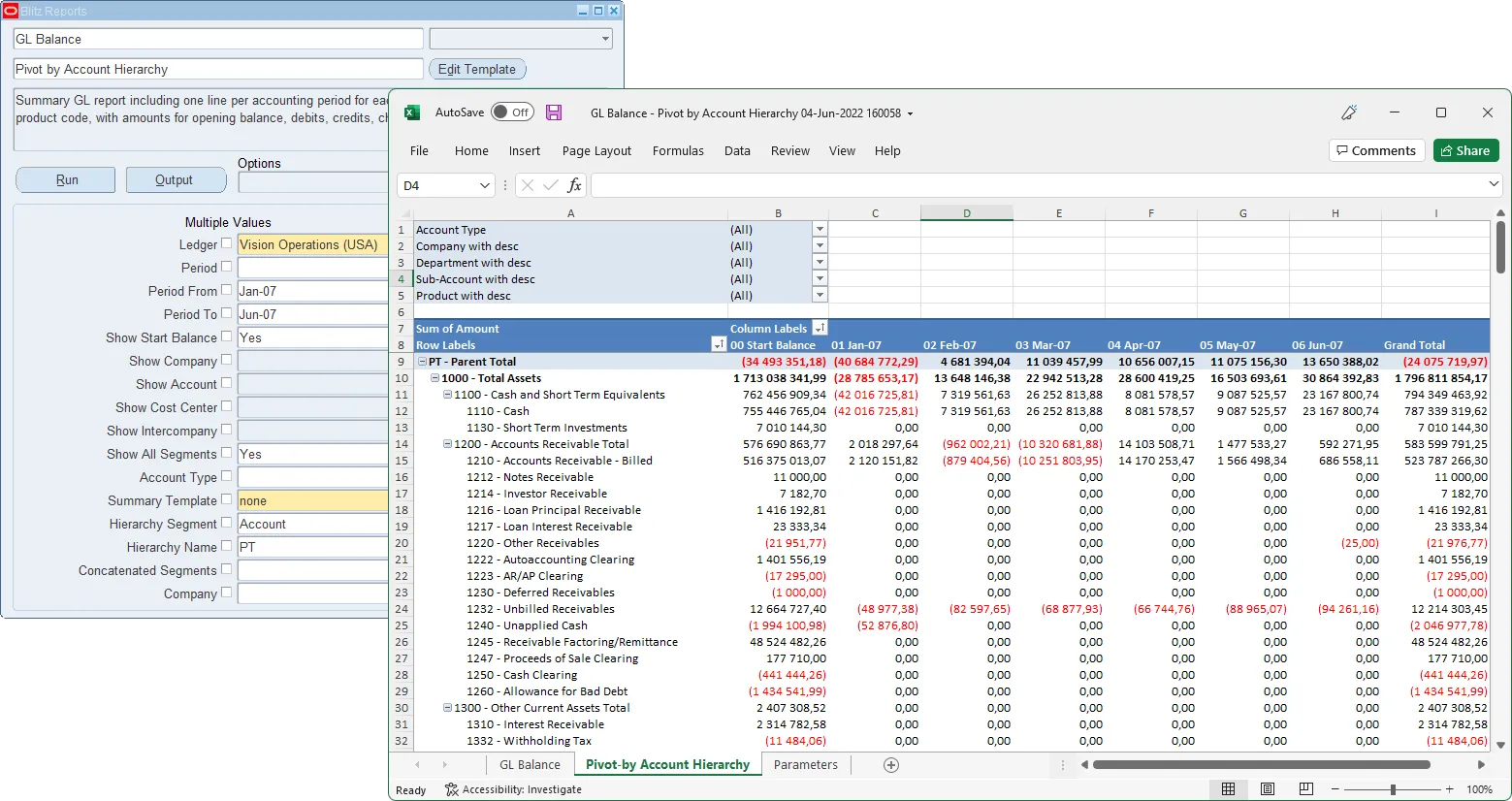
The Filters, Columns, Rows and Values fields are used to create and deliver the data in pivot table format with full drill down to details.
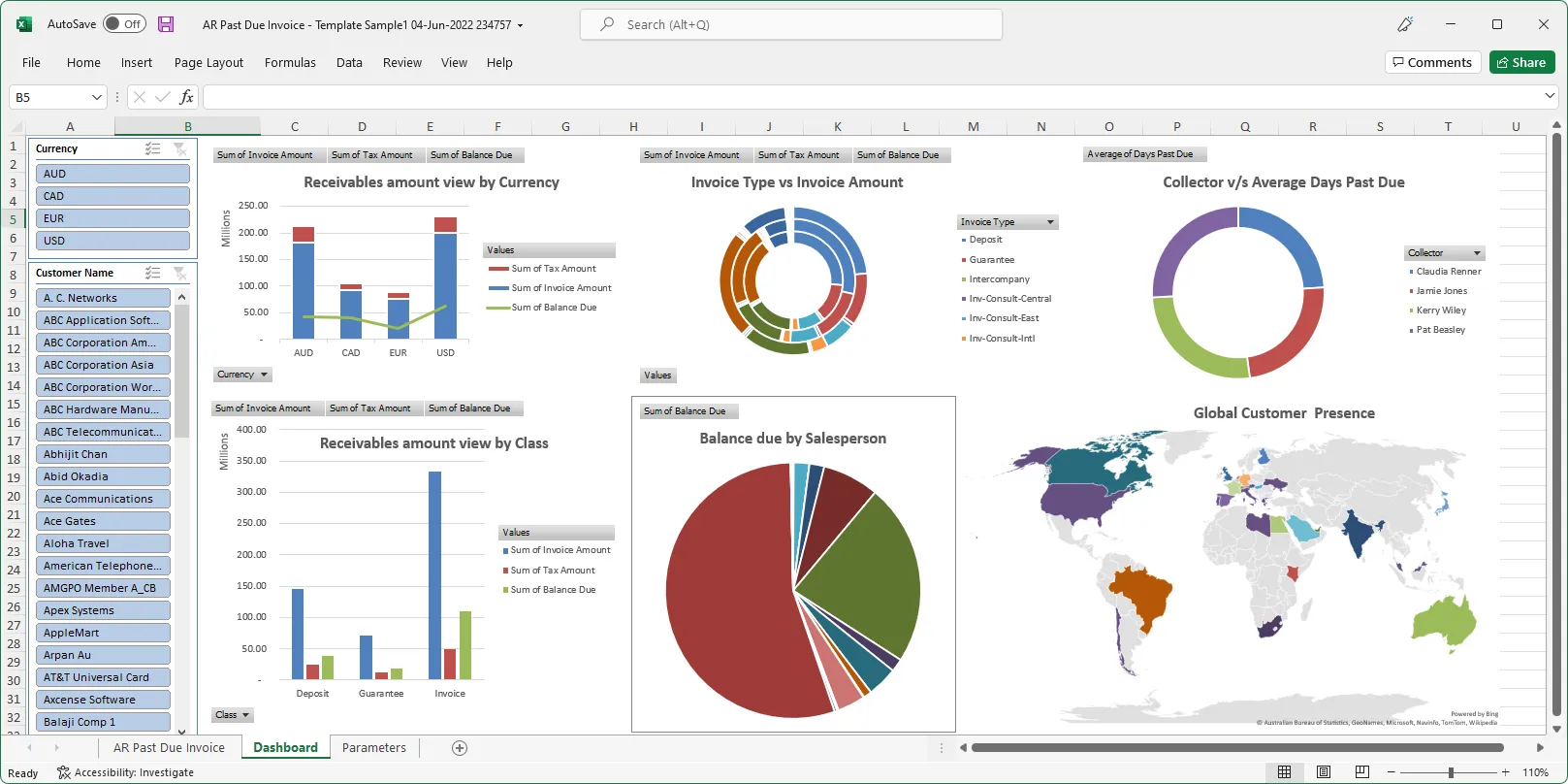
The Excel template upload functionality in Blitz Report allows users to create their own layouts by uploading an Excel template with additional sheets and charts, automatically refreshed when the report runs again. This allows to create custom dashboards and more advanced visualizations of report data.
You can download and use Blitz Report free of charge for your first 30 reports.
The installation and implementation process usually takes less than 1 hour; you can refer to our installation and user guides for specific details.
If you would like to optimize your Oracle EBS implementation and or operational reporting you can visit www.enginatics.com to review great ideas and example usage in blog. Or why not try for yourself in our demo environment.
Useful Links
Blitz Report™ – World’s fastest data upload and reporting for Oracle EBS
Oracle Discoverer replacement – importing worksheets into Blitz Report™
Blitz Report™ Questions & Answers
Supply Chain Hub by Blitz Report™
© 2025 Enginatics